
The agriculture ministry, in the last few weeks, issued guidelines and letters to states to ensure agriculture and food products reach consumers in a timely manner, while farmers don't have to come to the mandis to sell them.

The Centre and state governments are struggling to restart at least some industrial activity as it becomes apparent that the 21-day nationwide lockdown imposed to check the spread of coronavirus disease (Covid-19) could be extended beyond April 14, and stocks of essential commodities need replenishing across the country. State governments, particularly those like Delhi that witnessed an exodus of migrant workers after the lockdown was announced, say there are not enough labourers in the city to work in factories and warehouses.
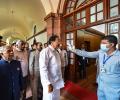
Many feel that the money from their MPLADS should go directly to a district hospital in their respective constituencies rather than a central fund like PM CARES. Archis Mohan reports.

IMD has said the temperature in April-June across most parts in India is expected to be 0.5-1 degrees Celsius warmer than normal. However, doctors and scientists say they haven't found any direct correlation between the speed of COVID-19 spread and warm weather.

Bureaucratic insensitivity gave way to compassion with the state administration, police and passersby joining forces to help the stream of Indians fleeing Delhi.

While the meetings on Friday were preliminary discussions, it is learnt that sectors like tourism; hospitality; aviation; micro, small and medium enterprises (MSMEs); and livestock have sought deferring loan repayments and temporary tax holidays in specific cases to help them tide over the steep fall in economic activity.

The India meteorological department has stated that day temperatures are likely to be above normal by 0.5 degree Celsius, reports Sanjeeb Mukherjee.

India is expected to harvest 291.95 mt of foodgrain in 2019-20
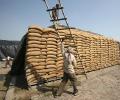
This is the highest in the past five years and almost 24 per cent more than last year.

Finance Minister Nirmala Sitharaman has brought down the budgetary allocation for the fertiliser subsidy for FY21 to Rs 71,309 crore, from the RE of Rs 79,998 crore for FY20, while increasing food subsidy to FCI through "ways and means advance" to Rs 50,000 crore for FY21, from Rs 36,000 crore in RE for FY20, and under the National Food Security Act (NFSA) to Rs 77,982 crore, from Rs 75,000 crore.

Kerala, Punjab and Rajasthan are the other three states to pass a resolution opposing the contentious legislation, reports Archis Mohan.

Sources said much has been done to ease the tax burden of the middle classes in the last five years, and that such a measure affects only a limited segment of people when the focus should be to put money in rural areas. Archis Mohan reports.

While rising food inflation is a matter of grave concern for a significant chunk of the population and for policy makers as well, it marks a turnaround in the fortunes of the farmer, reports Sanjeeb Mukherjee.
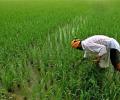
A pick-up in farmer income could have a cascading impact on the rural economy, though agriculture is becoming a smaller part of India's overall rural incomes.
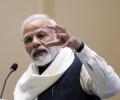
Starting today, Modi and top officials in the Prime Minister's Office will be briefed by various central ministries and departments on their plans as well as agenda for the next five years. They will also apprise the PMO of the work they have done so far in realising the agenda of government's second term in office.

In 2009, the UPA government, had announced a slew of measures to boost liquidity in NBFCs. These included a scheme for providing liquidity support to NBFCs having assets size of over Rs 100 crore through a SPV.

'If Indians are to be truly protected, Parliament must review and address these dangerous provisions before they become law.'

In the worst-case scenario, it will be next to impossible for tech companies like Amazon and Google to run any service that requires user biometrics.

In platforms, such as Twitter, Facebook, TikTok, Helo, and ShareChat, mediators have been asked to put in more hours to ensure that no communal or fake news spread.
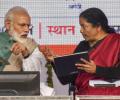
In the 2020-21 Budget, the prime minister and the finance minister are keen to stamp their narrative, after various rollbacks following the previous Budget, said top government sources. Besides the scheduled meetings, the sources said, the Prime Minister's Office is expected to hold several meetings with top secretaries and officials on various ongoing schemes, their performance and also how some of them could be tweaked for better results.
 © 2026 Rediff.com - Investor Information - Advertise with us - Disclaimer - Privacy Policy - Sitemap - Feedback - About us - Terms of use - Grievances